
A Grief Observed and The Problem of Pain
Two philosophical/theological explorations of suffering by C. S. Lewis

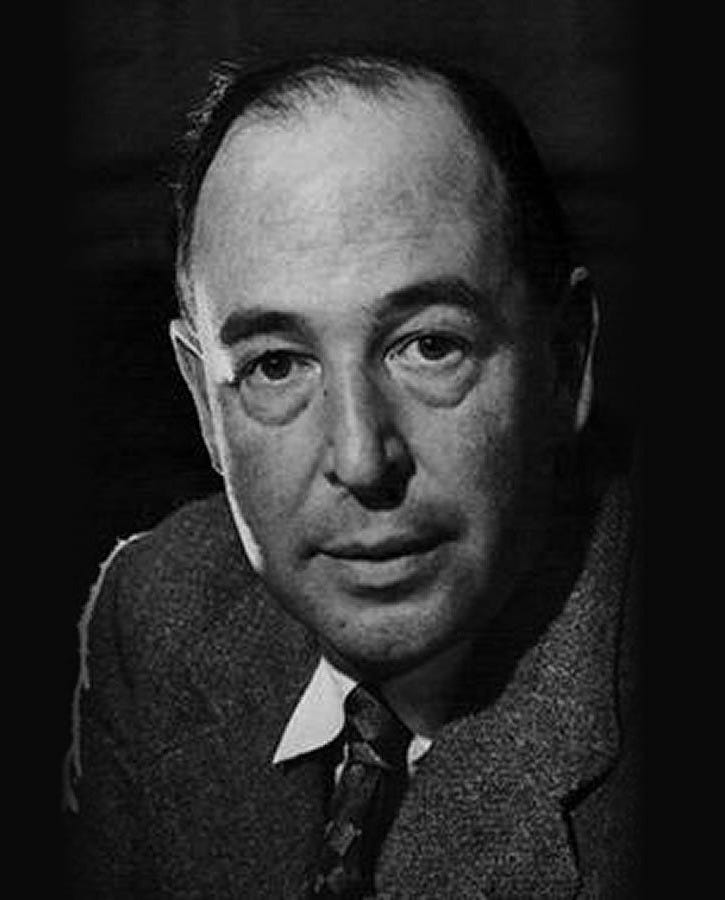
Of all the writers I’m using for this project, C. S. Lewis is undoubtedly the most famous. Whereas Henri Nouwen was primarily a theologian and Nicholas Wolterstorff primarily a philosopher, Lewis is a perfect blend of both, as well as a popular writer of fiction. He will probably always be most closely identified with The Chronicles of Narnia, but writings like Mere Christianity, The Screwtape Letters, Miracles, and The Four Loves are also very well-known among Christian audiences.
Lewis’s childhood was marked by the death of his mother when he was 10, soon followed by a staunch, intellectual atheism. As a young man, he fought and was wounded in World War I. When the war ended, he studied at Oxford, where he eventually became a professor. He befriended a man named J. R. R. Tolkien, and the two of them helped found a literary group called the Inklings. He converted to Christianity in 1931, ushering in three decades of theological, philosophical, poetic, fantasy, and even sci-fi writings. In 1952, at the age of 54, he started a correspondence with a woman named Helen Joy Gresham. Four years later, they were married. Four years later, she was dead. Like both of Lewis’s parents, the cause was cancer.
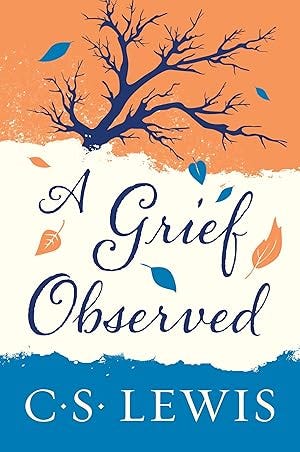
A Grief Observed (1961)
In the wake of Joy’s death, C. S. Lewis filled four small notebooks with thoughts, questions, and, yes, observations about how he was processing his grief. Though short, it is a very different read than any of his other works. He still possesses his sharp mind and insight, but his unique wit is completely absent, and his “voice” is noticeably subdued. He is desperately grasping at whatever straws he can. Like Nouwen, Lewis was initially reluctant to publish his notebooks. Though he eventually changed his mind, A Grief Observed (the four notebooks combined into one volume) was originally published anonymously. It was his last major work published in his lifetime. C. S. Lewis died on November 22, 1963, the same day as JFK and Aldous Huxley.
NOTE: Citations are going to be a bit annoying here, as I have both A Grief Observed and The Problem of Pain in a one-volume collection of seven Lewis works, titled The Complete C. S. Lewis Signature Classics. Rather than give the page numbers, which only helps those with the same exact text that I have, I will cite quotations using the chapter and paragraph in which they appear. Even though The Problem of Pain was published earlier, I will go through A Grief Observed first, then Problem.
“Meanwhile, where is God? This is one of the most disquieting symptoms. When you are happy, so happy that you have no sense of needing Him, so happy that you are tempted to feel His claims upon you as interruption, if you remember yourself and turn to Him with gratitude and praise, you will be – or so it feels – welcomed with open arms. But go to Him when your need is desperate, when all other help is vain, and what do you find? A door slammed in your face, and a sound of bolting and double bolting on the inside. After that, silence. You may as well turn away. The longer you wait, the more emphatic the silence will become. There are no lights in the windows. It might be an empty house. Was it ever inhabited? It seemed so once. And that seeming was as strong as this. What can this mean? Why is He so present a commander in our time of prosperity and so very absent a help in time of trouble?” (A Grief Observed ch. 1, ¶7)
Lewis’s starting point is familiar to so many of us: why is God silent when we call out for help? Why is God absent precisely when we need God most? Here Lewis echoes Nicholas Wolterstorff’s “Silence of the God Who Speaks” essay.
“I tried to put some of these thoughts to C. this afternoon. He reminded me that the same thing seems to have happened to Christ: ‘Why hast thou forsaken me?’ I know. Does that make it easier to understand?
Not that I am (I think) in much danger of ceasing to believe in God. The real danger is of coming to believe such dreadful things about Him. The conclusion I dread is not ‘So there’s no God after all,’ but ‘So this is what God’s really like. Deceive yourself no longer.” (Grief ch. 1, ¶8-9)
Another point of agreement with Wolerstorff, who called humanity’s wounds “an unanswered question” and showed God’s lofty, unfulfilled promises in Scripture (“It’s the speech of the biblical God that leads us to see that suffering and life-duration have gone awry with reference to God’s creating and maintaining intent”). Religious people struggling with pain risk losing their faith in God’s existence or God’s nature. For atheists who struggle with pain, both of those risks are absent. This is also a good reminder that what comforts one person won’t always comfort another. Jesus feeling abandoned by God on the cross makes me feel better when I feel abandoned by God. It doesn’t do anything for Lewis here. Comforting words is not a one-size-fits-all approach. Every person and situation is different.
“It is hard to have patience with people who say, ‘There is no death’ or ‘Death doesn’t matter.’ There is death. And whatever is matters. And whatever happens has consequences, and it and they are irrevocable and irreversible. You might as well say birth doesn’t matter. Is anything more certain that that in all those vast times and spaces, if I were allowed to search them, I should nowhere find her face, her voice, her touch? She died. She is dead. Is the word so difficult to learn?” (Grief ch. 1, ¶30)
More dialogue with both Wolerstorff and Henri Nouwen, both of whom refused to downplay the horror and reality of death. Here Lewis takes more of a stoic approach as he tries to face his wife’s death head-on.
“Talk to me about the truth of religion and I’ll listen gladly. Talk to me about the duty of religion and I’ll listen submissively. But don’t come talking to me about the consolations of religion or I shall suspect that you don’t understand.” (Grief ch. 2, ¶13)
Another reminder that what consoles one person doesn’t always console another. Nouwen was comforted enough by his faith to write A Letter of Consolation, a work that also brought comfort to Henri Nouwen. It is fair to say that this same text wouldn’t have helped Lewis, at least at this point in his grieving.
“The terrible thing is that a perfectly good God is in this matter hardly less formidable than a Cosmic Sadist. The more we believe that God hurts only to heal, the less we can believe that there is any use in begging for tenderness. A cruel man might be bribed – might grow tired of his vile sport – might have a temporary fit of mercy, as alcoholics have fits of sobriety. But suppose that what you are up against is a surgeon whose intentions are wholly good. The kinder and more conscientious he is, the more inexorably he will go on cutting. If he yielded to your entreaties, if he stopped before the operation was complete, all the pain up to that point would have been useless. But is it credible that such extremities of torture should be necessary for us? Well, take your choice. The tortures occur. If they are unnecessary, then there is no God or a bad one. If there is a good God, then these tortures are necessary. For no even moderately good Being could possibly inflict or permit them if they weren’t.
Either way, we’re for it.
What do people mean when they say, ‘I am not afraid of God because I know He is good’? Have they never even been to a dentist?” (Grief ch. 3, ¶17-19)
One of my favorite things about Lewis’s writing is his command of metaphors and analogies, in this case, God as a surgeon. He’s certainly not saying that all pain is good, or that pain is caused by God (it is fair to grant that suffering is, at least, permitted by God). But if suffering is a necessary part of life, this sounds like a good way to look at it. Lewis’s last quip (“Have they never even been to a dentist?”), three-quarters of the way through A Grief Observed, suggests that he is healing at least enough for his dry sense of humor to resurface.
“And then one babbles – ‘If only I could bear it, or the worst of it, or any of it, instead of her.’ But one can’t tell how serious that bid is, for nothing is staked on it. If it suddenly became a real possibility, then, for the first time, we should discover how seriously we had meant it. But is it ever allowed?
It was allowed to One, we are told, and I find I can now believe again, that He has done vicariously whatever can be so done. He replies to our babble, ‘You cannot and you dare not. I could and dared.’” (Grief ch. 3, ¶19-20)
In the first chapter, Lewis brushes off the relevance of Jesus feeling abandoned by God. In the second chapter, he rejects “the consolations of religion.” Here, in the third chapter, he is finally able to let his faith comfort him on his own terms.
“Five senses; an incurably abstract intellect; a haphazardly selective memory; a set of preconceptions and assumptions so numerous that I can never examine more than a minority of them – never become even conscious of them all. How much of total reality can such an apparatus let through?” (Grief ch. 4, ¶11)
“When I lay these questions before God I get no answer. But a rather special sort of ‘No answer.’ It is not the locked door. It is more like a silent, certainly not uncompassionate, gaze. As though He shook His head not in refusal but waiving the question. Like, ‘Peace, child; you don’t understand.’
Can a mortal ask questions which God finds unanswerable? Quite easily, I should think. All nonsense questions are unanswerable. How many hours are there in a mile? Is yellow square or round? Probably half the questions we ask – half our great theological and metaphysical problems – are like that.” (Grief ch. 4, ¶24-25)
We might never know why we suffer. Maybe the answers are too big for our limited consciousnesses. But surely the questions are still worth asking, even if the answers are too big for us. We should still try to be morally good even though we’ll never be perfect. Maybe existential questions are like morality – you’ll never fully reach it, but don’t stop trying. I think Wolterstorff, who also wrote about God’s silence, would agree with Lewis in these paragraphs. Lewis’s take isn’t fully satisfying, but it is enough.
“How wicked would it be, if we could, to call the dead back! She said not to me but to the chaplain, ‘I am at peace with God.’ She smiled, but not at me. Poi si tornò all’ eterna fontana.” (Grief ch. 4, ¶24-25)
Lewis’s final farewell to his wife at the very end of A Grief Observed. The Italian, from Dante’s Paradise, translates to “Then she turned back to the Eternal Fountain.”
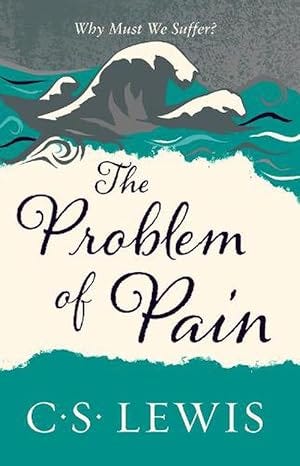
The Problem of Pain (1940)
23 years before his death, and 21 years before A Grief Observed, Lewis published The Problem of Pain. If Grief is a deeply personal, specific exploration of one man’s grief, Problem is a more general, academic study of pain in general. It is much more of a theodicy than Grief, with each of its ten chapters focusing on a different area related to pain: questions of divine omnipotence and goodness (remember Epicurus’ paradox), human wickedness, the fall of man, human pain, animal pain, hell, and heaven.
If A Grief Observed is perhaps too personal and raw at times for a comprehensive study of suffering, The Problem of Pain is occasionally too formal and academic. I won’t be mining either of them as thoroughly as I did A Letter of Consolation or especially Lament for a Son. Still, both texts are quintessential parts of the C. S. Lewis canon and are generally useful for our exploration of why we suffer and what to do with our suffering. I highly recommend them both to anyone.
“We are, not metaphorically but in very truth, a Divine work of art, something that God is making, and therefore something with which He will not be satisfied until it has a certain character. Here again we come up against what I have called the ‘intolerable compliment.’ Over a sketch made idly to amuse a child, an artist may not take much trouble: he may be content to let it go even though it is not exactly as he meant it to be. But over the great picture of his life – the work which he loves, though in a different fashion, as intensely as a man loves a woman or a mother a child – he will take endless trouble – and would, doubtless, thereby give endless trouble to the picture if it were sentient. One can imagine a sentient picture, after being rubbed and scraped and recommenced for the tenth time, wishing that it were only a thumbnail sketch whose making was over in a minute. In the same way, it is natural for us to wish that God had designed for us a less glorious and less arduous destiny; but then we are not wishing for more love but for less.” (The Problem of Pain ch. 3, ¶10)
Another classic C. S. Lewis metaphor, somewhat similar to God-as-surgeon in A Grief Observed. As with any metaphor, no matter how helpful, it is easy to see where this breaks down. Extreme, unjust, destructive suffering doesn’t seem to apply here. Scraping, rubbing and restarting a painting is one thing, but stabbing, ripping or burning the canvas is something else.
This image describes the “soul-making theodicy,” in which we undergo pain and trouble in order to be made more perfect. While modern philosophers like John Hick wrote much on this theodicy, the term was actually coined by the poet John Keats, who wrote about “a vale of tears from which we are to be redeemed by a certain arbitrary interposition of God. […] Call the world if you Please ‘The vale of Soul-making.’ […] Do you not see how necessary a World of Pains and troubles is to school an Intelligence and make it a Soul?” (“The Soul-Making Theodicy” in Readings in the Philosophy of Religion pg. 314)
“When God becomes a Man and lives as a creature among His own creatures in Palestine, then indeed His life is one of supreme self-sacrifice and leads to Calvary.” (Problem ch. 3, ¶17)
Another example of the motif “God suffers with us” that keeps popping up in these writings. I also, of course, want to highlight Lewis’s use of the word Palestine to describe the region where Jesus was born. Lewis wrote this in 1940, eight years before the State of Israel was formed and 750,000 Palestinians were forced from their land in the Al-Nakba. Anyone who believes that the present-day State of Israel is the same as the Israel in the Bible is geographically, biblically, and factually confused.
“There is a paradox about tribulation in Christianity. Blessed are the poor, but by ‘judgement’ (i.e., social justice) and alms we are to remove poverty wherever possible. Blessed are we when persecuted, but we may avoid persecution by flying from city to city, and may pray to be spared it, as Our Lord prayed in Gethsemane. But if suffering is good, ought it not to be pursued rather than avoided? I answer that suffering is not good in itself. What is good in any painful experience is, for the sufferer, his submission to the will of God, and for the spectators, the compassion aroused and the acts of mercy to which it leads.” (Problem ch. 7, ¶2)
All of this seems to track, with the possible exception of a sufferer needing to submit to the will of God. A starving, double amputee child in Gaza is not the will of God, and that child should not view her situation as such. God does not will the death and suffering of children, or of any of us. God sees and grieves the suffering of those in Gaza. And as God does so, and as Lewis writes, so should we. We should be moved to compassion and acts of mercy. But so often, particularly with Gaza, so many of us can barely be moved to look.
The nod to the Beatitudes echoes Wolterstorff, and the explicit instruction of social justice, coming from an old, conservative theologian, is a heartwarming surprise.
“If tribulation is a necessary element in redemption, we must anticipate that it will never cease till God sees the world to be either redeemed or no further redeemable. A Christian cannot, therefore, believe any of those who promise that if only some reform in our economic, political, political, or hygienic system were made, a heaven on earth would follow. This might seem to have a discouraging effect on the social worker, but it is not found in practice to discourage him. On the contrary, a strong sense of our common miseries, simply as men, is at least as good a spur to the removal of all the miseries we can.” (Problem ch. 7, ¶2, my emphasis)
C. S. Lewis delves even deeper into the need for social justice here. He anticipates potential pushback from those on the far left and/or atheists, and I largely agree with him. I think the word “only” in the second sentence is incredibly important, hence my added emphasis. “Heaven on earth” will not come about only from political or social reform. Does that mean we should stop working towards those ends? Absolutely not. The final sentence in this passage brings it home beautifully.
“‘I reckon,’ said St Paul, ‘that the sufferings of this present time are not worthy to be compared with the glory that shall be revealed in us.’ If this is so, a book on suffering which says nothing of heaven, is leaving out almost the whole of one side of the account. Scripture and tradition habitually put the joys of heaven into the scale against the sufferings of earth, and no solution of the problem of pain which does not do so can be called a Christian one. We are very shy nowadays of even mentioning heaven. We are afraid of the jeer about ‘pie in the sky,’ and of being told that we are trying to ‘escape’ from the duty of making a happy world here and now into dreams of a happy world elsewhere. But either there is ‘pie in the sky’ or there is not. If there is not, then Christianity is false, for this doctrine is woven into its whole fabric. If there is, then this truth, like any other, must be faced, whether it is useful at political meetings or no.” (Problem ch. 10, ¶1)
Romans 8:18, which Lewis quotes in the first sentence here, has been my single favorite Bible verse since I first encountered it in middle school. You almost never see it in books or sermons – it tends to get passed over in favor of more popular verses from the chapter like 8:28 and 8:38. But 8:18 has been central to my life for about a quarter-century. When I was younger, I viewed it a bit unhealthily, putting too much of an emphasis on heaven at the expense of life on earth. As I grew older, I viewed it with more nuance and balance. Paul and C. S. Lewis are both talking about the “already but not yet” view of earth, heaven, and the end times. The Kingdom of God is here on earth as much as it is a future place/reality. It is already here, but not yet come. Another paradox, as we’ve seen with Epicurus, Henri Nouwen, G. K. Chesterton, Nicholas Wolterstorff, and the Beatitudes of Jesus Christ himself. So yes, there is “pie in the sky by and by,” and it is ok to long for it. According to Paul, that future glory will outweigh our present sufferings. But! Paul equivocates on whether he’s talking about glory on earth or glory in heaven, “already” or “not yet.” Yes, there will be pie in the sky. But it is our job, if we are Christians, to bring the kingdom of heaven to earth. And that means bringing the pie to earth, even just for a taste. This was why Jesus came to earth to live, suffer, and die. “I tell you, the hour is coming and is now here" (John 5:25).
Let me close by reiterating that I am not trying to preach or convert people to Christianity. I’m merely a Christian lens because I’m a Christian. These last three essays have been very religious in nature because they’ve used theological and philosophical texts. The final two will rely on a psychiatrist and a poet and should be less religious.
I also want to acknowledge that these essays aren’t my best work. There’s not much structure, I’m essentially just giving extended quotations with commentary, and it’s starting to get a little muddled and unwieldly. I truly think the Wolterstorff essay will be the longest in the series, and I am looking forward to doing different, more original work after I tackle Victor Frankl and Ted Rosenthal. I hope at least one of these essays, even just one of the quotes, is helpful for someone struggling in 2025.
This essay is dedicated to C. S. Lewis’s wife Helen Joy Gresham and my own wife Mel. Be well, stay safe, free Palestine, fuck Trump/ICE, have hope, and God bless.
-DS
“I love words, I thank you for hearing my words, I want to tell you something about words that I think is important. I say they’re my work, my play, they’re my passion. Words are all we have, really.”
-George Carlin (1937-2008)
“No matter what anyone tells you, words and ideas can change the world. […] We are members of the human race. And the human race is filled with passion. And medicine, law, business, engineering, these are noble pursuits and necessary to sustain life. But poetry, beauty, romance, love, these are what we stay alive for.”
-Robin Williams (1951-2014)
Further Reading by C. S. Lewis
The Screwtape Letters
Mere Christianity
The Great Divorce
Miracles
The Four Loves
Suprised by Joy
The Weight of Glory
God in the Dock
The Chronicles of Narnia